

The KIIT Model
An edited volume on localising the Sustainable Development Goals - how one institution translates global ambitions into education, healthcare, research, infrastructure, sport, culture, and international partnership.
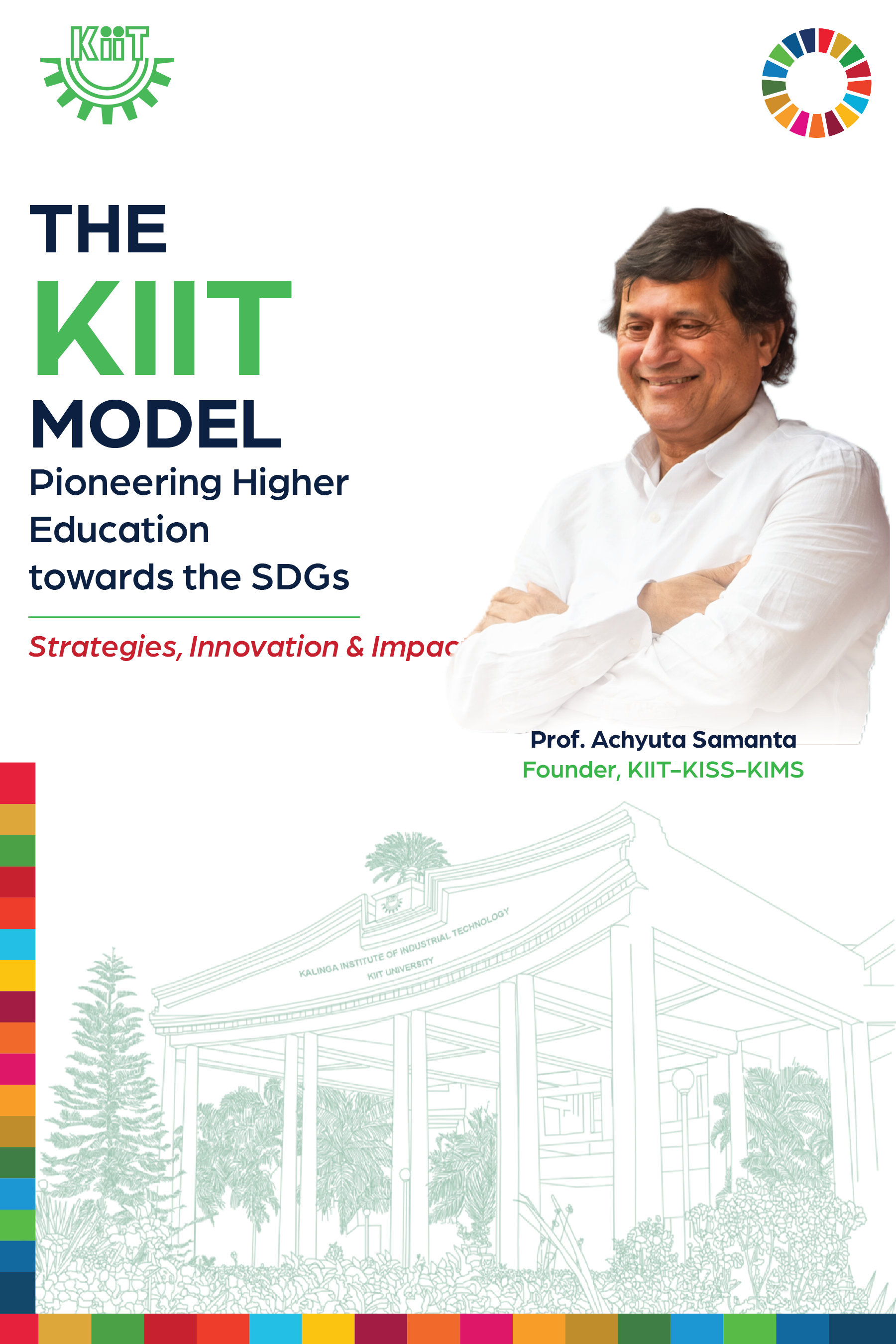
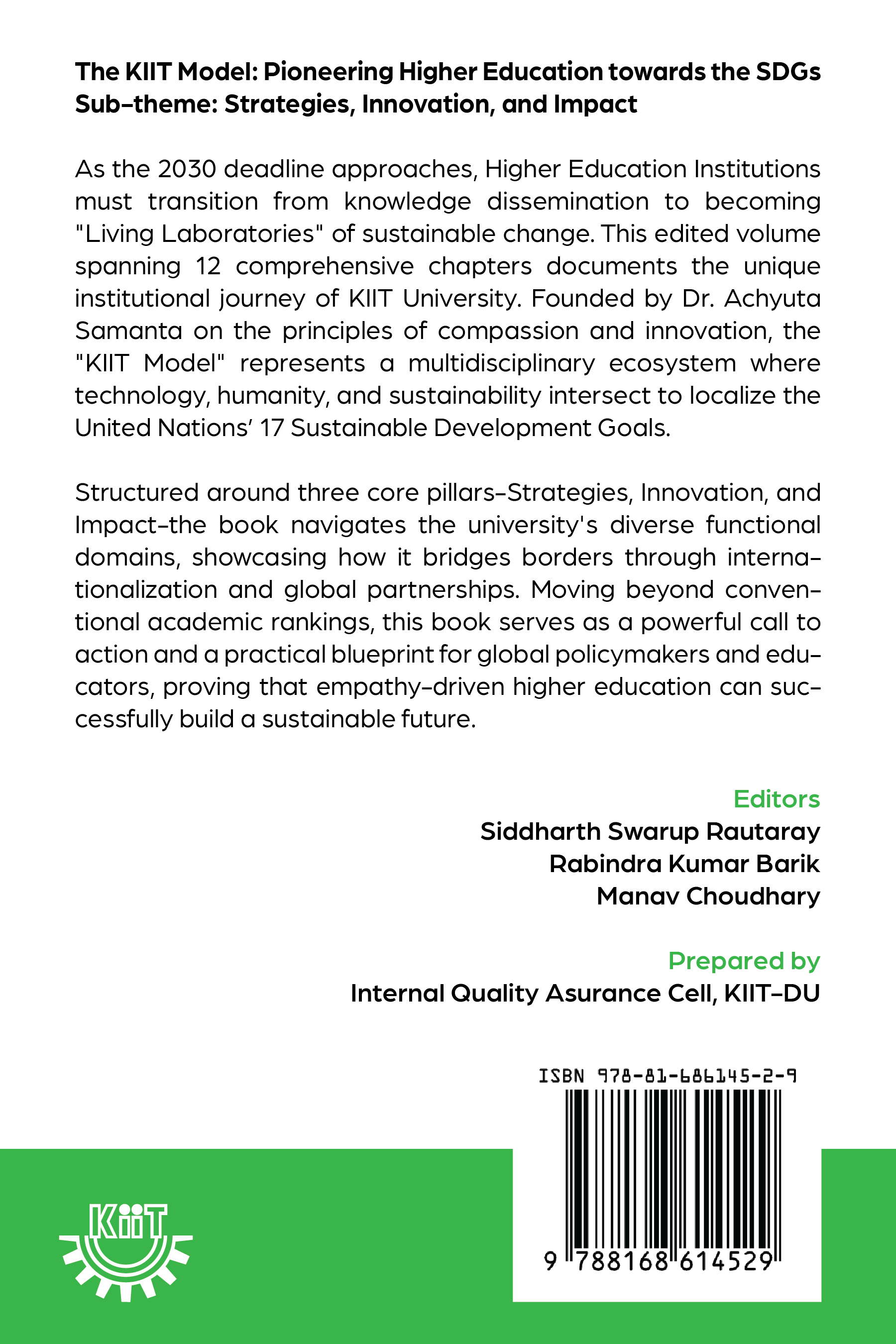
- Editors
- Siddharth Swarup Rautaray, Rabindra Kumar Barik, Manav Amit Choudhary
- ISBN (Print)
- 978-81-686145-2-9
- ISBN (eBook)
- 978-81-686145-0-5
- Published by
- IQAC KIIT
The Architect of Inclusive Transformation: The Vision of Prof. Achyuta Samanta
Manav Choudhary, Siddharth S. Rautaray, Rabindra K. Barik, Madhusmita Sahoo
KISS as a Microcosm of SDG Localisation: Tribal Empowerment Through Education-Led Development
Biswajyoti Pani, Shreeparna Roy
Healing with Heart: Kalinga Institute of Medical Sciences as a Catalyst for SDGs
Soumya Sonalika, Debasis Pradhan, Sinjit Mukherjee
Education Without Barriers: Localising the SDGs through the KIIT's Transformative Ecosystem
Laxmi P. Samantaray, Siddharth S. Rautaray, Rabindra K. Barik
Bridging the Regional Innovation Gap: The KIIT-TBI Deep-Tech Model as a Catalyst for Sustainable Development
Upasana Panda, Jyotsnarani Jena
Catalyzing Sustainable Innovation and Partnerships: Lessons from the KIIT Central Research Facility (CRF) Model
Upasana Panda, Aritra Krishna De
Building Sustainable and Resilient Campuses: Localizing the SDGs through KIIT's Physical and Digital Infrastructure
Kirtikanta Sahoo, Dipti Ranjan Biswal, Soumya Mishra
Beyond the Finish Line: KIIT's Sports Ecosystem as a Catalyst for Sustainable Development
Ananya Mitra, Smrutirekha Mohanty
The Stone as a Stakeholder: KIIT's Sculpture Heritage as a Catalyst for SDG Localization
Laxmi P. Samantaray, Siddharth S. Rautaray, Rabindra K. Barik
The Living Laboratory of Sustainability: KIIT's Green Campus as a Model for SDG Localisation
Soumya Mishra, Roshan Nayak, Kirtikanta Sahoo
Bridging Cultures, Building Futures: KIIT's Internationalisation Paradigm for Sustainability
Vikash Anand
Vasudhaiva Kutumbakam in Action: Strategic Global Collaborations Driving Institutional Excellence
Manav Choudhary, Siddharth S. Rautaray, Rabindra K. Barik
In an era defined by complex global challenges, ranging from deep-seated socioeconomic disparities to the compounding crises of climate change, the United Nations Sustainable Development Goals (SDGs) serve as a critical roadmap for human survival and flourishing. While these goals are global in scope, their ultimate success hinges entirely on local implementation. Higher education institutions stand at the vanguard of this movement. They are uniquely positioned to act not merely as passive observers of change, but as primary engines of societal transformation, localized progress, and community empowerment.
The KIIT Model: Pioneering Higher Education towards the SDGs provides an analytical, multi-dimensional exploration of how Kalinga Institute of Industrial Technology (KIIT) and its sister institution, Kalinga Institute of Social Sciences (KISS), have systematically operationalized this mandate. This edited volume consolidates twelve distinct yet deeply interconnected chapters into a comprehensive institutional blueprint. Grounded in empirical experience and structural evolution, the book is organized around three foundational pillars that define the ethos of the KIIT model: Strategies, Innovation, and Impact.
Pillar I: Strategies for Inclusive Transformation
True institutional alignment with the SDGs cannot occur through superficial compliance or ad-hoc initiatives; it demands deliberate, foundational strategy. The first movement of this volume deconstructs the overarching philosophical and structural policies that have steered KIIT toward systemic equity.
This strategic journey originates with the visionary leadership of Prof. Achyuta Samanta, whose lifelong commitment to eradicating poverty through education serves as the moral compass of the entire ecosystem. This vision finds its most profound expression in the historic work of KISS, which serves as a global microcosm of SDG localization by empowering thousands of indigenous children through free, high-quality, residential education.
The institutional strategy further expands into public well-being through the Kalinga Institute of Medical Sciences (KIMS), illustrating how compassionate healthcare education and accessible medical infrastructure can directly advance community health resilience. Concurrently, the volume evaluates the democratization of learning at KIIT, presenting a robust framework for removing structural barriers to ensure equitable, lifelong learning opportunities for diverse student populations.
Pillar II: Innovation across Technology, Infrastructure, and Culture
Innovation within the KIIT model is conceptualized broadly, extending far beyond traditional laboratory settings to encompass infrastructure, ecology, and cultural preservation. The second section of this volume highlights how higher education can creatively leverage its physical, digital, and intellectual assets to pioneer localized solutions.
The book highlights the Kalinga Institute of Industrial Technology's Technology Business Incubator (KIIT-TBI), demonstrating how an academic institution can successfully anchor a deep-tech entrepreneurial ecosystem in Eastern India, converting academic research into market-ready social enterprises. This is supported by an analysis of the Central Research Facility (CRF), which provides a model for centralized, high-impact scientific infrastructure capable of driving multi-disciplinary breakthroughs.
Furthermore, the volume turns inward to examine the campus itself. It evaluates the synthesis of robust physical and digital infrastructure that underpins sustainable operations, alongside an exploration of KIIT's green campus as a "living laboratory"-a physical pedagogical space where ecological conservation is practiced in real time.
Crucially, the book also captures unconventional dimensions of institutional innovation. It highlights the strategic use of sports as a powerful instrument for social inclusion, gender equity, and character building, while offering a unique cultural perspective that frames traditional stone sculpture heritage not merely as art, but as an active, stakeholder-driven catalyst for cultural preservation and community identity.
Pillar III: Global Impact and Shared Horizons
The ultimate validation of any localized strategy lies in its capacity to scale, connect, and resonate globally. The final movement of this volume examines how the KIIT model transcends regional borders to fulfill the mandate of SDG 17 (Partnerships for the Goals).
Through an analytical look at the institution's internationalization paradigms, the text demonstrates how cross-border academic mobility, collaborative research networks, and cultural diplomacy build bridges for a sustainable world. The book culminates in a philosophical and operational reflection on the ancient ethos of Vasudhaiva Kutumbakam-the profound conviction that the world is one single, interconnected family. This concluding section demonstrates how strategic global collaborations, when properly aligned with institutional values, drive academic excellence while fostering global citizenship.
Audience and Intent
This edited volume is designed specifically for university administrators, global policymakers, sustainability researchers, and higher education strategists. By meticulously documenting the methodologies, successes, and systemic frameworks of KIIT and KISS, this book does not merely seek to chronicle institutional milestones. Rather, it serves as an empirical, adaptable reference guide for institutions worldwide. It stands as a definitive proof of concept: when a higher education institution aligns its core mission with its profound socio-ecological responsibilities, it becomes an unparalleled catalyst for a just, equitable, and sustainable world.
Access
For access to the full text, contact [email protected]